

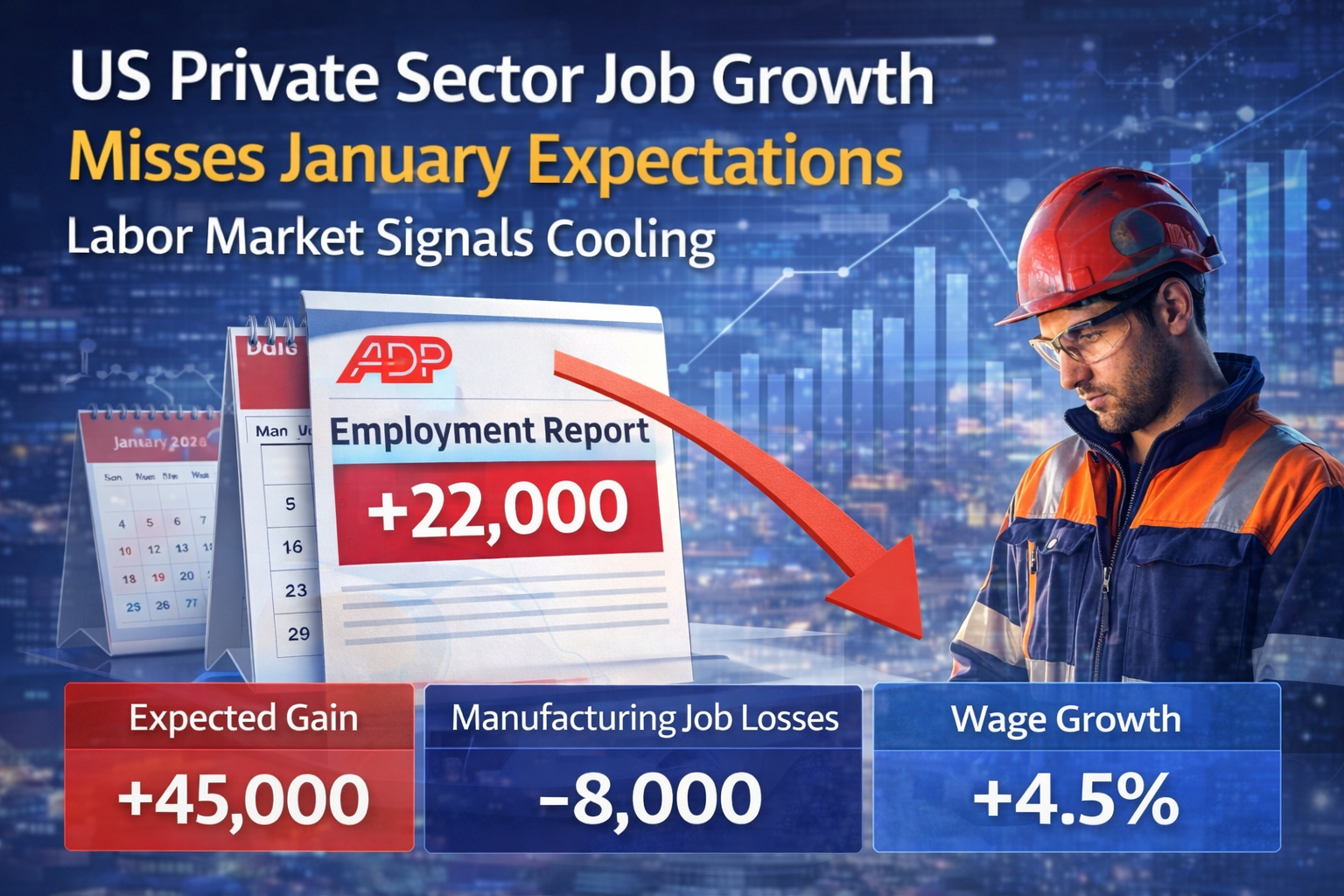
US private sector job growth: The United States private labor market opened the year with weaker-than-expected momentum, as January hiring figures released by payroll processor ADP revealed a sharp slowdown in employment growth. The report showed that private employers added just 22,000 jobs, significantly below analyst forecasts and December’s revised totals, raising fresh questions about the trajectory of the US job market entering 2026.
While certain sectors — particularly education and health services — continued to expand payrolls, manufacturing posted notable job losses, reinforcing concerns that goods-producing industries remain under pressure. The January figures also arrive amid broader uncertainty, including delayed federal labor data and cautious Federal Reserve policy positioning.
This article breaks down what the numbers mean, which industries are driving the slowdown, wage trends, economic implications, and what employers, job seekers, and policymakers should watch next.
January Hiring Falls Short of Expectations
According to ADP’s National Employment Report, US private employers added 22,000 jobs in January, nearly half of what economists had projected. Analysts surveyed prior to the release expected approximately 45,000 new positions, reflecting moderate but stable hiring growth.
The January figure also trails December’s revised 37,000 jobs, highlighting a continued deceleration in private-sector job creation.
ADP characterized the month as “lackluster”, signaling that employers are becoming increasingly cautious in workforce expansion after several years of post-pandemic hiring volatility.
The slowdown is particularly notable because January often reflects early-year hiring adjustments, budget resets, and workforce planning cycles. Instead, companies appear to be adopting a more defensive approach, prioritizing productivity over headcount expansion.
Manufacturing Sector Drives the Slowdown
One of the most striking findings in the report was the continued contraction of manufacturing employment.
Manufacturing payrolls declined by 8,000 positions in January, marking yet another month of job losses. ADP noted that the sector has now shed jobs consistently since March 2024, underscoring ongoing structural pressures.
Several factors are contributing to the manufacturing downturn:
- Softer global demand
- Supply chain recalibration
- Inventory normalization
- Automation investments
- Export headwinds
Goods-producing industries broadly lagged behind services, reflecting a shift in economic activity toward consumption-driven and service-oriented sectors.
Economist Matthew Martin of Oxford Economics summarized the trend:
“Hiring remains concentrated in the services sector, while goods-producing industries continue to struggle.”
This imbalance suggests a structural transition in labor demand rather than a universal employment contraction.
Services Sector Continues to Add Jobs
Despite the headline slowdown, certain segments of the economy continued to generate employment.
Education and health services led January gains, reflecting persistent demand for:
- Healthcare professionals
- Administrative staff
- Educational support roles
- Clinical and care services
These industries benefit from demographic trends, rising healthcare utilization, and institutional staffing needs that remain less sensitive to economic cycles.
Professional services also maintained modest expansion, though hiring intensity softened compared to prior quarters.
The divergence between services growth and manufacturing contraction illustrates how labor demand is evolving across sectors.
Job Losses Span Employer Sizes
Another key insight from the January report is that employment softness was not limited to a single employer category.
ADP found job losses occurring across:
- Small businesses
- Mid-sized firms
- Large enterprises
This suggests broader caution in hiring decisions rather than sector-specific restructuring alone.
Companies appear to be balancing workforce efficiency with economic uncertainty, opting for lean staffing models while monitoring growth conditions.
Labor Market Cooling Raises Broader Economic Questions
The ADP report arrives against a backdrop of growing attention on the health of the US labor market.
While unemployment remains historically moderate, the pace of hiring has slowed significantly compared to previous years. ADP chief economist Nela Richardson noted:
“Job creation took a step back in 2025, with private employers adding 398,000 jobs — down sharply from 771,000 in 2024.”
Richardson described the trend as part of a broader multi-year deceleration, even as wage growth remains relatively steady.
The slowdown does not yet signal recession conditions, but it reflects a transition from rapid recovery hiring to a more mature labor environment.

Wage Growth Shows Stability Despite Hiring Softness
While employment gains weakened, wage growth remained resilient.
ADP reported:
- Workers who stayed in their jobs saw 4.5% year-over-year pay growth
- Job switchers experienced 6.4% annualized wage increases, slightly cooler than prior months
Stable wage growth indicates:
- Continued competition for skilled labor
- Inflation-adjusted compensation pressure
- Employer efforts to retain experienced workers
However, the gradual cooling of wage acceleration suggests that labor demand is stabilizing rather than overheating.
Federal Data Delay Adds Uncertainty
Ordinarily, the ADP report serves as a preview of official government employment figures. However, January’s federal labor report was delayed due to a temporary government shutdown.
The US Labor Department has rescheduled the official nonfarm payrolls release for February 11, leaving analysts temporarily reliant on private data.
This delay complicates market interpretation because ADP and government methodologies differ. While ADP offers an early snapshot, the federal report provides broader industry coverage.
Investors and policymakers will closely compare the two once official figures arrive.
Implications for Federal Reserve Policy
Labor market conditions remain a central factor in Federal Reserve decision-making.
The Fed previously implemented three interest rate cuts amid employment softening, but policymakers have since paused further reductions while evaluating economic stability.
Matthew Martin suggests that signs of labor market stabilization may allow the Fed to maintain current rates until midyear rather than accelerating easing.
A slower hiring environment reduces inflation pressure but also raises concerns about economic momentum.
The Fed must balance:
- Labor market health
- Wage growth trends
- Inflation stability
- Consumer spending patterns
January’s hiring softness reinforces the importance of careful policy calibration.
Structural Shift in Hiring Trends
The broader employment picture suggests a shift away from rapid expansion toward efficiency-focused workforce management.
Companies are increasingly prioritizing:
- Productivity gains
- Automation integration
- Skill specialization
- Cost discipline
Rather than aggressive headcount growth, employers are emphasizing targeted hiring aligned with strategic objectives.
This transition reflects maturation in the post-pandemic labor cycle.
How Job Seekers Should Interpret the Data
For workers and job seekers, the January report signals a more competitive environment — but not a contraction.
Key takeaways:
- Service-sector roles remain strong
- Specialized skills retain value
- Wage growth supports job mobility
- Manufacturing job seekers may face tighter conditions
Candidates who emphasize adaptability, technical expertise, and cross-functional capability are better positioned.
Employer Strategy in a Cooling Labor Market
Businesses navigating slower hiring conditions may focus on:
- Workforce optimization
- Internal mobility
- Retention strategies
- Automation investment
- Selective recruitment
Companies balancing growth ambitions with economic caution will likely maintain disciplined hiring frameworks.
Outlook: Stabilization Rather Than Collapse
Despite weaker January figures, economists largely view the labor market as stabilizing — not deteriorating.
Employment growth has slowed from extraordinary highs but remains positive overall.
Upcoming federal labor data will provide clearer confirmation of whether January represents a temporary pause or a sustained cooling trend.
US private sector job growth: Conclusion
January’s US private-sector hiring slowdown underscores a broader recalibration in labor market dynamics. Manufacturing weakness, tempered job creation, and stable wage growth collectively paint a picture of an economy transitioning from rapid recovery to measured expansion.
While hiring momentum has softened, service-sector resilience and wage stability indicate underlying labor strength.
As official employment data arrives and Federal Reserve policy evolves, businesses and workers alike will watch closely for signals about the direction of the US economy in 2026.

