
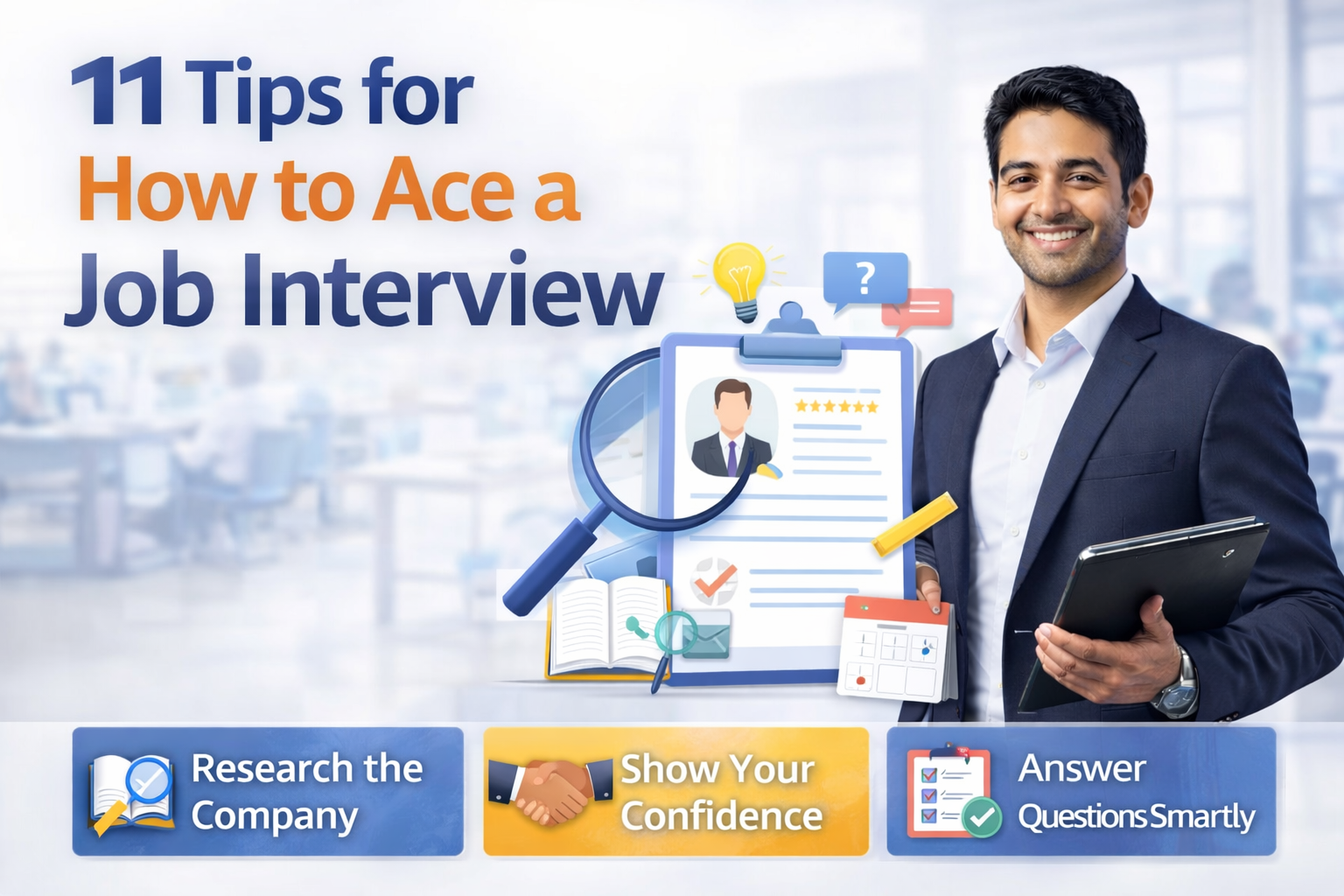
How to ace a job interview: Landing an interview is exciting — your resume impressed the employer, and now it’s time to prove you’re the right hire. But interviews can feel intimidating, especially when stakes are high. The good news? Interview success isn’t about luck. It comes from preparation, confidence, and smart communication. If you want to know how to ace a job interview, this 2026 guide walks you through 11 practical, proven strategies that hiring managers actually look for.
Why Interview Preparation Matters
Interviews test more than qualifications. Employers evaluate:
- Confidence
- Communication skills
- Cultural fit
- Problem-solving ability
- Professional mindset
Candidates who prepare properly appear calm, articulate, and reliable — traits that often matter just as much as technical skills.
Tip 1: Research the Company Like a Professional
Confidence begins with knowledge.
Before your interview, study:
- Company mission and values
- Products or services
- Recent achievements
- Leadership team
- Competitors
- Industry trends
Also review their social media presence to understand company culture.
When you demonstrate awareness, interviewers see commitment and genuine interest — not just job hunting desperation.
👉 Pro insight: Prepare 2–3 examples showing how your skills align with the company’s goals.
Tip 2: Dress for the Role — Not Just the Interview
Appearance influences first impressions within seconds.
Match your attire to company culture:
- Corporate finance → formal business wear
- Creative agency → smart casual
- Tech startup → polished minimal
Choose clothing that is:
✔ Comfortable
✔ Professional
✔ Confidence-boosting
Practice wearing your outfit beforehand to avoid awkward adjustments or discomfort.
Tip 3: Master Common Warm-Up Questions
Warm-up questions are inevitable:
- Tell me about yourself
- Why should we hire you?
- What are your career goals?
Your answer should:
- Highlight relevant achievements
- Show personality
- Connect to the role
Avoid reciting your CV word-for-word. Instead, tell a focused story about your professional journey.
👉 Think: background → skills → value → future direction.
Tip 4: Handle Tough Questions Strategically
Interviewers often test self-awareness with questions like:
“What’s your biggest weakness?”
Never say:
❌ “I don’t have weaknesses.”
Instead:
✔ Choose a real challenge
✔ Show improvement
✔ Link to productivity
Example:
“I used to overcommit to projects, but I’ve learned to prioritize efficiently — which actually improved team workflow.”
This shows maturity, reflection, and growth.
Tip 5: Prepare for Creative or Brain-Teaser Questions
Some employers test thinking ability with unexpected prompts:
“If you were a tool, what would you be?”
These questions evaluate:
- Creativity
- Critical thinking
- Communication
Stay calm, think logically, and answer with personality.
Example:
“I’d be a multi-tool — adaptable, efficient, and useful in different situations.”
No right answer — just clear reasoning.
Tip 6: Know When to Pause and Regain Control
If a question catches you off guard:
✔ Take a breath
✔ Ask for clarification
✔ Request time to revisit
Avoid rambling or panic responses.
Confidence isn’t knowing everything — it’s managing uncertainty professionally.
Use sparingly; overusing this tactic suggests poor preparation.
Tip 7: Be Honest About Career Gaps or Changes
Interviewers appreciate transparency.
If you have:
- Employment gaps
- Career pivots
- Study breaks
Explain what you gained:
- Skills
- Certifications
- Freelance work
- Personal growth
Even downtime can demonstrate resilience and learning.
Tip 8: Show Your Value Through Stories
Stories make skills believable.
Instead of saying:
❌ “I’m a strong team player.”
Say:
✔ “During a tight deadline project, I coordinated tasks and ensured delivery 2 days early.”
Concrete examples build credibility.
Use the STAR method:
Situation → Task → Action → Result
Tip 9: Ask Smart Questions at the End
When interviewers say:
“Do you have any questions?”
Never answer:
❌ “No.”
Ask thoughtful questions like:
- What does success look like in this role?
- What challenges does the team face?
- How does the company support growth?
This shows curiosity, engagement, and long-term thinking.
Tip 10: Practice Verbal and Non-Verbal Communication
Interview success isn’t just what you say — it’s how you say it.
Maintain:
✔ Eye contact
✔ Open posture
✔ Clear voice
✔ Active listening
Avoid:
❌ Slouching
❌ Fidgeting
❌ Interrupting
Body language communicates confidence and professionalism instantly.
Tip 11: Follow Up Professionally
Within 24 hours, send a thank-you email:
- Express gratitude
- Reinforce interest
- Mention a discussion highlight
This small gesture keeps you memorable.
Example:
Thank you for the insightful conversation. I’m excited about the opportunity to contribute to your team.
Bonus: Interview Day Checklist
✔ Resume copies
✔ Portfolio (if relevant)
✔ Notepad and pen
✔ Questions prepared
✔ Professional attire ready
✔ Travel plan confirmed
Preparation reduces anxiety dramatically.
Common Interview Mistakes to Avoid
❌ Arriving late
❌ Talking negatively about past employers
❌ Overconfidence or arrogance
❌ Lack of preparation
❌ Rambling answers
❌ Phone distractions
Professionalism always wins.
FAQs — How to Ace a Job Interview
How can I reduce interview anxiety?
Preparation and mock interviews build confidence.
Should I memorize answers?
Practice structure — don’t memorize scripts.
What if I don’t know an answer?
Pause, think, respond logically.
How long should answers be?
Clear and focused — avoid overexplaining.
Can personality help in interviews?
Yes. Authentic confidence and warmth stand out.
How to ace a job interview: Conclusion
Knowing how to ace a job interview is about preparation, clarity, and self-awareness.
Employers don’t expect perfection — they want candidates who demonstrate:
✔ Confidence
✔ Communication
✔ Professionalism
✔ Problem-solving mindset
Prepare smart, present yourself clearly, and treat the interview as a conversation — not an interrogation.
Success follows preparation.